Who doesn’t know Microsoft? It’s one of the biggest companies in the world. Its chairman is one of the most recognized names. So when the company prepared to launch its first upgrade to the Windows operating system in five years, everybody was talking.
Steven Ballmer, Microsoft’s ceo, called the Windows Vista launch the biggest in company history, with a first-year marketing budget totaling hundreds of millions of dollars. The buzz prompted some loyal high-tech fans to line up outside of stores at midnight in January.
But what about the non-techies – the average consumer who knows Microsoft, knows about the upgrade, but still needs an extra push to purchase?
Parisa Zander, Microsoft’s group manager of visual merchandising worldwide, explains the consumer must understand what to buy and why to buy within the first 15 seconds. “If not,” she says, “you’ve lost them.” Her rules of engagement are simple: When a customer views a Windows Vista endcap, he or she should be captured from 20 feet away. To do this, Zander and her team developed internal partnerships among Microsoft’s subsidiary offices. Only then could they create a unified visual program that would command that 15 seconds of fame on the sales floor. With succinct messaging and consistent iconic elements, the program would continue to interest shoppers after the glitz and grandeur of the launch was over.
But once that partnership was in place, Zander had to create another partnership, with the retailers that would be carrying the merchandise. Microsoft has the benefit of being a commonly recognizable brand. The flowing flag-like window icon has had the same colors (red, green, yellow, blue) since Windows 3.1x launched in 1992. And the new Windows Vista and Office programs also bear the iconic four-color branding.
Advertisement
But retailers like Best Buy and CompUSA have their own visual identities. How much latitude would they be willing to allow Microsoft to establish its identity in the stores? Behind the barrage of digital displays on New York street corners, human billboards and storewide celebrations, how strong a brand statement could Microsoft make where it really mattered – on the sales floor?
First Piece of the Puzzle
Eighteen months ago, Zander and her team began the quest for a universal look at retail. “We thought, ‘Wouldn’t it be great if you were able to go to London or Tokyo or Los Angeles and Microsoft’s visual all looked the same?’” she says. “For years, you could go from one Microsoft display in a store to another and never know they came from the same company.”
With so many Microsoft sub-brands, it had been difficult to get every division on board for a unified visual program. This time, though, “We were able to get people out of their silos and committed to bringing Microsoft visual under one umbrella,” Zander says. The company used the Vista and Office launches to roll out its first “one Microsoft” look and feel initiative.
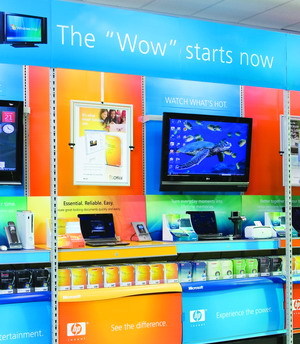
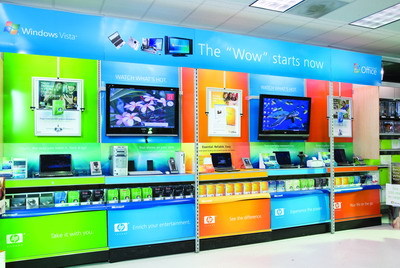
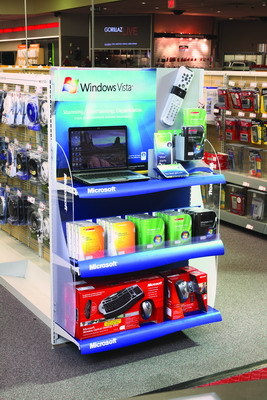
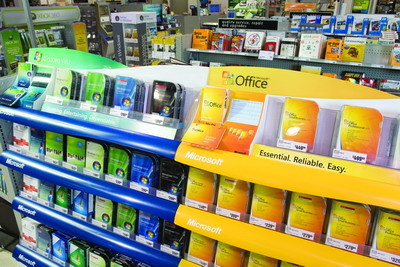
The four signature Microsoft colors remained the visual cue in the new program. Yellow denotes the Office programs, green, the Windows Vista business system. Large iconic elements, or “call outs,” such as an oversized mouse or camera, frame the overall endcap and coincide with the messaging. “We were able to streamline the messaging to make the why-to-buy clear,” Zander says. Phrases like “Essential. Reliable. Easy.” adorn Microsoft Office endcaps, for example.
Advertisement
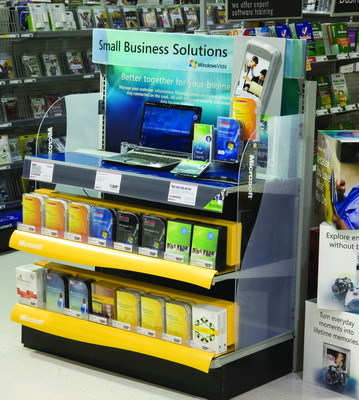
Curves were introduced as visual elements into the endcaps and inlines, something internally referred to as “the wave.” Displays are topped with an undulating ribbon of color, and curving translucent fins flank endcaps. A frosted wave design contrasts with the clear fins and enables space for the Microsoft logo.
Additional elements, such as touchscreens and informational flip books, work to engage the customer with quick information on the operating system. And if a retail sales staff member isn’t around, an interactive demo in select stores walks the consumer through the nuances of Windows Vista and Office.
Making It Happen
Microsoft organized itself on the home front. But creating a new visual program also meant working with retailers that Microsoft trusts to push, promote and sell its product. “Everyone was willing to support this launch,” Zander says. “It was a true partnership.”
Zander and her team worked closely with retailers’ visual merchandising departments to incorporate the Microsoft visual identity into stores. “Circuit City had not yet rolled out its in-store look,” Zander says. “We showed them drafts of what we wanted and how we could incorporate their brand into our plan to make everyone happy.”
Advertisement
But the program wasn’t just in Circuit City and Best Buy. Discount big boxes such as Wal-Mart and Target also tout Microsoft’s visual identity.
“Slight tweaks in the messaging appeal to each store’s target audience,” she explains. “A customer in Best Buy is different than one in Wal-Mart, and we were very cognizant of whom we were speaking to, but the look didn’t change.”
According to Zander, the Best Buy target audience is a more tech-savvy male; Wal-Mart is all about moms. “She literally has 15 seconds to walk by and read something because she’s got Junior in the cart and he’s going ballistic.”
To appeal to these customers, the team developed “key scenarios” that highlight benefits like productivity or digital entertainment within the system.
“In Best Buy, we focused on the small business environment with the ‘productivity’ scenario,” explains Zander. “At Wal-Mart, we emphasized family, using the ‘digital entertainment’ scenario.” So the messaging appeals not only to parents looking to use spreadsheets to organize bills, but also to kids, with its Xbox extender.
Lasting Impression
Microsoft also teamed up with its branding and advertising groups, ensuring that TV spots, radio and other media all tied in to what was happening at retail.
“The Wow Starts Now” tagline being used globally on billboards and print ads has been woven into the retail look, but it is not a main focal point. “We didn’t want to date ourselves,” Zander says. “If there was any chance of the endcap living more than 10 months, we needed to have a more generic Vista messaging. In cases where we knew the endcap would be in place for three to nine months, we kept the Wow tagline.”
In introducing a new operating system, Microsoft has set a company precedent with its new retail look, what it feels is a benchmark for in-store marketing that it hopes will help alleviate consumer confusion and tie all Microsoft products at retail together.
So all over the world, Microsoft consumers are seeing the same wow.
Photography: Jeremy Dunham, Portland, Ore.








 Headlines1 week ago
 Photo Gallery23 hours ago
 Headlines2 weeks ago
 Headlines2 weeks ago
 Sector Spotlight1 week ago
 Headlines1 week ago
 Headlines1 week ago
 Headlines2 days ago