Nothing still communicates to shoppers – information, directions, promotions, emotions – like in-store signage.
According to this year's third annual VM+SD signage and graphics survey, more than 96 percent of respondents report their retail organizations are spending more on their graphics programs this year (51.4 percent) or about the same (44.9 percent). Only 3.7 percent said they'd be spending less.
And those budget figures seem healthy. Nearly 65 percent said they'll be spending more than $100,000 this year. Nearly 40 percent said their budgets would be upwards of $500,000. More than 23 percent indicated spending of more than $1 million (Chart E).
And why not? Whether they're converting some of their signage to Spanish, as Cingular Wireless recently announced it was doing or melding a number of different brands into one, as Federated Department Stores will be doing this year for its nationwide Macy's chain, retailers know printed graphics are the quickest, most efficient media for talking to their shoppers.
The graphics must work on a variety of levels, from the most basic and temporary – pricing, sales promotion and p-o-p – to the most sophisticated and permanent, conveying the brand's message and providing clear and durable wayfinding.
They must also communicate quickly and creatively how the shopping promise will be delivered. As a result, much of the creative content now falls to the visual merchandising department. The survey revealed that visual merchandising is the single most important group in the retail organization commanding signage and graphics decisions. It's a combination of getting the creative message right and making it a unified one.
“At our company, all creative services work together,” says Tracey Peters, national visual and merchandising director for Holt Renfrew, Canada's fashion department store. “This includes all print, books, signage, visual and merchandising, to ensure a cohesive look throughout.”
“Because the needs for graphics are increasing, the visual teams are taking an active role in the types of products and media used, as well as the vendor base,” agrees Karen Meskey-Wilson, vp, store planning and visual standards, J.C. Penney. “Visual has a key yes-or-no vote on most of these things.”
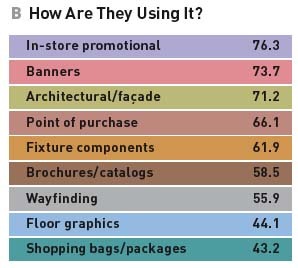
Whether conveying a new national brand or promoting a Labor Day 25 percent-off program, signage is in the forefront of all retailers' plans. In VM+SD's survey, respondents indicated certain trends and tendencies: signage is still most often used for in-store promotional uses, exteriors and banners (Chart B); paper, vinyl, metal and wood are still the most popular substrates (Chart C); and quality of printing and customer service are retailer's most important requirements in selecting vendors (Chart D).
It also appears an increasing amount of that signage will be dynamic, updatable and interactive. Nearly 61 percent of respondents said they will be increasing the use of in-store digital media next year (though most said it will not be replacing existing traditional signage and graphics programs). And 75 percent of those said budgets will be increased to accommodate the new installations – mostly for in-store promotional (51.7 percent), lifestyle/branding (33.9 percent) and point-of-sale (33.9 percent) purposes. Also for internal purposes, such as training salespeople.
“It's difficult for us to get the same kind of training penetration with retail associates as we can get with a 30-second demo,” says Parisa Zander, group manager, visual merchandising, for Microsoft Corp. “As we know, it's harder and harder to find good retail associates that understand all our technology. Interactive demos help alleviate much of the confusion at retail. So this becomes a training mechanism.”
However, 58 percent of those who will be increasing the use of in-store digital media said it will not replace traditional signage and graphics programs.
“I don't see printed signage being supplanted by digital media any time soon,” says Nancy Devine, group manager at Target Corp. “We will continue to use ISDM very strategically – for example, for information and branding.”
“Content management, distribution and hardware needs are all still quite excessive when compared to static signage,” says Penney's Meskey-Wilson. “And the vendor base is scattered over many different parts of the industry. There is no one-stop shop, no matter what the vendors promise. That puts the burden on the retailer to come up with the right mix for its in-store experience.”











 Headlines1 week ago
 Headlines2 weeks ago
 Specialty Apparel1 week ago
 Headlines1 week ago
 Press Release1 week ago
 Specialty Non-Apparel2 days ago
 Specialty Non-Apparel1 week ago
 Headlines2 weeks ago