In-store marketing (which used to be called point of purchase or point of sale) focuses on the micro-environment of brand retailing, primarily at shelf level: capturing the attention of the consumer to produce sales lift and the moving of inventory.
Retail consolidation, changes in mass-media marketing and consumers' ability to tune out traditional media have put renewed emphasis on generating product excitement at the store level. “It appears that the store is fast becoming the best place to inspire consumers to become customers, and shoppers to become buyers,” according to Peter Hoyt, executive director of the InStore Marketing Institute.
Which means brand marketers are faced with two increasing truths: They better understand the customer; and they better understand the importance of effective store concept, layout and design. To that end, the recent InStore Marketing Summit (in Oakbrook, Ill., in April) added in-depth case study sessions about the necessary research tools and techniques required to gain those better understandings and a new emphasis on overall store design.
Dan O'Connor, founder and chairman of Management Ventures Inc. (a retail research firm following the 600 largest retailers), noted that retail marketing models are on the brink of change as the market becomes saturated. Fifty percent of all retail sales (excluding automobiles) go through the top 300 retailers overall. But O'Connor predicted only 90 of 325 top retailers will actually gain share in the future. The best opportunity for growth is to grab market share. “The big are eating the big, not robbing from small retailers,” said O'Connor.
Advertisement
To differentiate themselves from their competitors, big retailers are refining marketing position, creating shopping occasions, adding services targeted to key customers, improving private label offerings and packaging, establishing clean store policies, improving sightlines, lowering shelf height and reducing promotional signage.
Tony Schiano, president and ceo of Giant Food Stores, a 260-store chain headquartered in Carlisle, Pa., showcased the new Giant Super Foods in Camp Hill, Pa. Facing competition from price clubs and supercenters, the food retailer opened a prototype store in October 2005 employing some innovative merchandising techniques – such as less signage and no floor decals – and improved customer service. The 91,200-square-foot store features numerous customer amenities, such as an enhanced health and wellness focus, two in-store nutritionists, a community center, meeting rooms, a cooking school and supervised play area for children. Schiano says Giant is planning to partner with regional and national manufacturers on a program to share shelf real estate with its store brand. “The store (itself) has become a critical communications medium,” he noted.
At last, the partnership of overall store design and in-store marketing is being recognized. That was the message from no less than Wal-Mart. Barry Moehring, the retail giant's vp, marketing operations, said its latest strategy in the war for market share is to “evolve the 'mass' experience – one shopper at a time.”
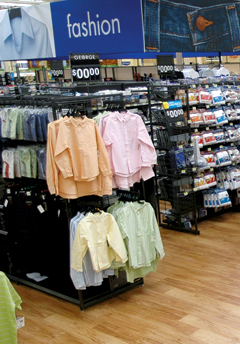
Moehring said Wal-Mart intends to do this by improving its understanding of the local customer and community and emphasizing value rather than just low prices. The new, highly publicized Wal-Mart supercenter in the competitive retail corridor of Plano, Texas, features an expanded and diversified grocery sort, a wine section with 1200 different selections, wider aisles, better navigation, low-profile fixturing, lifestyle graphics, a quieter shopping experience, a multi-dimensional façade and even faux wood flooring in some departments. The store is being positioned as “an active laboratory” to test concepts as the mega-retailer opens 1800 stores over the next 18 months. “No two Wal-Marts will look alike,” promised Moehring.
Advertisement
And the underlying promise (or threat) to retailers and brand marketers alike: Wal-Mart is showing it can go upscale, if it wants to, or green, if it wants to, or high-concept design, if it wants to, or follow any retail strategy at all, if it wants to – because it can!
Next year's Summit is scheduled for spring, 2007, in the Chicago area. For more information, go to www.instoremarketer.org.









 Headlines1 week ago
 Headlines2 weeks ago
 Specialty Apparel2 weeks ago
 Specialty Apparel1 week ago
 Headlines1 week ago
 Press Release1 week ago
 Specialty Non-Apparel2 days ago
 Specialty Non-Apparel7 days ago